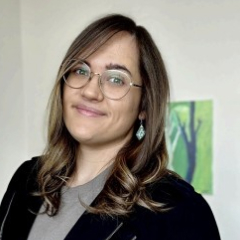
Image description: I am a white non-binary person with long brown hair. I am wearing glasses and a black shirt. Behind me is an artwork and a window. I am using American Sign Language (ASL).
Hello! My name is Carlisle Robinson. My sign name is made with an ‘L’ handshape. Then, bend your index finger. Finally, move it to a space in front of the eye / side of the head and move it up / down, as if you are moving glasses up and down.
0:50
Welcome to my exhibition! I am really excited for us to show the journeys we, participants in the Sync residency, have embarked on. Each participant’s journey has inspired me to include their journeys in my artwork.
My journey began when we talked about what our leadership metaphor is. We were asked to choose one. After careful consideration, a metaphor popped into my mind! It is the Paper Birch tree. I will sign it like this (signing as if my left hand is a tree and my right hand is peeling the bark). The reason is that the Paper Birch Tree has peeling bark.
Image: Screen changes to photos of Paper Birch trees. They’re thin white trees with peeling bark.
I picked it because I grew up with one in my backyard in Indiana. Also, that tree is famous for being used as paper by people in ancient times. People would engrave writings onto the bark. Several people practiced writing with it.
The most famous example is the ones done by a little boy named Onfim.
Image: Childish engravings of drawings of two people, with words next to them.
Image: the actual paper birch that has faded from time, and the re-draw of his drawing on the birch. Onfim wrote, “I am a beast.” with a drawing of himself as a fictional fire breathing creature.
His drawings and writings still survive to this day, about 800 years later. Very cool, eh?
I also am on a journey to practice ASLwrite, a sign language writing system. It was introduced in the 2010s, but still has only a few users. It needs to be shared more! Not enough of us learn, practice, or regularly use it. I want to encourage more learners.
I thought about what helped me with reading and writing. You see, my first language is ASL. English is my second language. So, I read a lot of comics to help with my English. This is how I sign comics. (The sign looks like I am making comic panels on my hand).
Being a bookworm with comics has tremendously helped me improve my English. Comics are very accessible with visual storytelling combined with writing. Seeing actions in comics helped me to understand even unknown words.
I was naturally led to making a comic with the paper birch tree.
Here’s my process of creation. (I have never created art with the birch)
I tried pencils, markers, and even my grandma’s old clay tools, as they have sharp ends for engraving onto the bark. Some tools worked well, some did not. If you scroll down this page, you can see my progress with a bit more explanation.
Ultimately, I found that markers are the best. They show up very well on the birch. I can scratch / engrave into the bark with pencils or soft blunt tools. But I noticed that it is harder for people to see the drawings. Pencils give it a shiny sheen, and engravings sometimes don’t contrast well with the bark.
Also, the paper birch bark is very fragile. It is too easy to accidentally tear or break it. So I went with using markers.
As I shopped for materials, I decided on using black paper to see if I could play around with gluing the birch onto it. Originally, I intended to create a single artwork. But my creation process led me to create a comic!
So here’s the comic story! The working title is ‘Seeds’. I am not sure if I will go with that title. Perhaps I’ll still like it, or I’ll change it to something else. But for now, the title is ‘Seeds.’
The story has 8 panels.
The story talks about a child who was forcibly dragged into the forest by a woman. You’ll see that the woman is carrying a rope on her shoulder. What is her intention in taking the child into the forest?
I want to recognize that a long time ago… actually, some might still do this… when a disabled child was born, the family sometimes freaked out and didn’t want to keep the child. They’d dump the child into the mountains, or the forest. We need to recognize these horrible actions, this dark history.
We also see that there’s another child in a tree. We see that the dragged child and the woman are dressed in the late 1800s / early 1900s. The child in the tree is dressed like they’re from medieval times. Why? What does it mean? Perhaps the tree child is the spirit of the child who was thrown into the forest a long time ago? And their spirit continues to live on in the tree?
As the story progresses, we’ll see that both children experience a tragedy. But it ends with finding hope in resilience. This is a metaphor for many of us who are Deaf and/or disabled. We have gone through a long history of attempts to destroy us, drive us away, divide us into isolation, and deprive us of our equal rights to education and access. Despite that, we are still here, still stubborn, and still strong. We keep growing again and again. They cannot completely destroy us.
As the famous Deaf activist leader, George Veditz, once said, “As long as there are Deaf people, we will always have sign languages.” We should cherish sign languages, the languages that are 100% accessible to Deaf people.
And, with the last panel, I included the metaphors used by fellow Sync participants in our residency. Maybe you can find them?
So that’s the main artwork I did. I also have other miscellaneous small artwork and artwork that I created from playing around and experimenting.
So, enjoy!